Free shipping for US orders over $150
Free shipping for US orders over $150
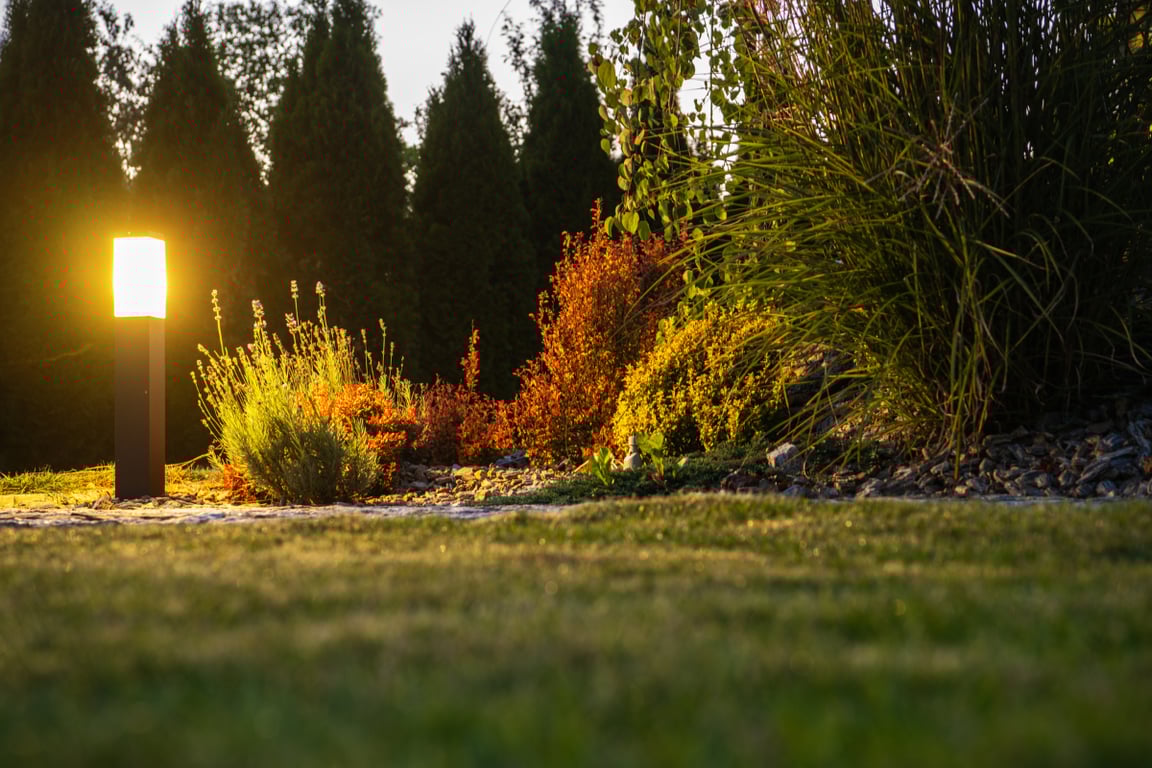
You may wish to design a new outdoor light system or add to what you already have. Many people feel great that they’ve taken on this task at all. But planning for future lighting needs can save energy, minimize maintenance, and enhance your outdoor enjoyment. Focus on four points to future-proof your setup: transformer capacity, LED efficiency, smart controls, and weather durability. Let’s look at how to get started and plan for expansion, too.
Choose a quality transformer – it’s the heart of your system. It converts household voltage down to a safe 12- or 24-volt level that powers every fixture. A properly sized unit gives you room to breathe, while an undersized one forces you to replace it prematurely.
Go with a model with multi-tap voltage outputs, typically 12V, 13V, 14V, and 15V taps. These allow you to compensate for voltage drop over long wire runs by “boosting” the output slightly at the source.
Why would you need multi-tap outputs? Gardens that span more than 50 feet from the transformer need extra voltage so distant fixtures stay bright. Here’s how to plan it out:
Calculate your total wattage load first (add up every bulb you plan to use, plus 20 percent extra for safety), then select a transformer rated at least 20 percent above that figure.
Best Pro Lighting sells quality transformers that will provide the performance you need today and for years to come.
Most people add to their garden light setups. Planning for expansion now can save time and money later. Run extra conduit or direct-burial cable from your transformer to key areas during the initial install.
Set these areas up now, and recheck periodically.
Your plants, trees, and other features may change over time, and you’ll be ready with upgraded lighting.
Why do you often hear that LED lights are better for your outdoor systems? LED low voltage landscape lighting uses up to 90 percent less energy, and the bulbs last 25,000 hours or more. Talk about future-proofing your setup! With LEDs, you’ll get roughly 20 years of nightly use. They run cooler, reducing fire risk around dry mulch or wooden structures, and they maintain their color and brightness for years.
Note how we discussed multi-tap outputs above, which will help prevent voltage drop issues.
Smart controls make your outdoor lights adjustable to your mood and time of day. Add photocells, motion sensors, and app-based controllers so your lights only come on when needed. Automation future-proofs your investment by making it adaptable to changing routines without rewiring fixtures.
Your local climate dictates which materials and designs you need to stand up to the elements.
When you match your outdoor lighting system to your geography, you dramatically extend its lifespan and maintain that “just installed” look year after year.
Check these points when you do your installation and recheck periodically:
If your transformer is running at 90 percent capacity and you want to add even three more fixtures, upgrade rather than patch. When more than 30 percent of your bulbs have failed or show color shift, the labor cost of repeated replacements usually exceeds the price of a full LED retrofit. If wiring is brittle, corroded, or undersized after a decade of use, pull new cable while you’re at it.
The rule of thumb is simple: if the repair cost exceeds 40 percent of a new system’s price or if the current setup can’t support smart controls, it’s time to upgrade. You’ll gain efficiency, reliability, and modern features in one clean project.
Take a few minutes to evaluate your garden lighting needs and plan for not only now but also the future. Best Pro Lighting offers all the fixtures, transformers, and accessories to make your lighting layout just the way you want it. When you shop on our site, you can receive free shipping for US orders over $150.00. Get all the outdoor light products you need now from Best Pro Lighting!
Q: What does it mean to future-proof a garden lighting system?
A: Plan ahead by adding in some of the new technology on offer so you can enjoy superior light performance now and in coming years.
Q: How much extra capacity should my landscape lighting transformer have?
A: Factor in 20 percent more wattage than your current load. This lets you add a few extra fixtures and not overload the transformer.
Q: Can I upgrade my garden lighting to LED without replacing the transformer?
A: Before you do, check if your existing landscape lighting transformer has enough unused capacity and multi-tap outputs.
Q: How long does a low-voltage transformer last?
A: If it’s protected from the weather, a quality unit can last 15–20 years.
Q: What causes outdoor landscape lighting systems to fail early?
A: The top culprits are voltage drop from undersized wire, water intrusion into unsealed fixtures or enclosures, overloading the transformer, and using non-UV-resistant or non-weatherproof materials.

Opening Hours
Monday – Friday 7:30am - 3:30pm PST

Need Help?
Fast answers to common questions.

Stay in the Loop
Be the first to know about new arrivals, sales & tips — it's free!