Free shipping for US orders over $150
Free shipping for US orders over $150
When setting up garden lights, understanding low-voltage landscape lighting—especially wattage, voltage, and load—is a common challenge. What do these terms mean, and why do they matter?
If you’re using a landscape transformer or landscape lighting transformer, getting these basics right is essential for performance, safety, and long-term reliability. This guide breaks everything down in a clear, practical way.
Low voltage lighting is the most popular option for outdoor and garden lighting systems. Unlike standard household power (120V), low voltage landscape lighting typically operates at 12 volts, making it safer for outdoor use and easier to install.
A landscape lighting transformer is the heart of the system. It converts standard household voltage into low voltage power that your garden lights can safely use. Without the right transformer—and the right calculations—your lighting system may underperform or fail altogether.
Have you ever noticed garden lights that look dim, flicker, or stop working entirely? In many cases, the issue isn’t the fixture—it’s a mismatch between wattage, voltage, and load.
Understanding how these three elements work together helps you:
Let’s break each one down.
Wattage measures how much power each light fixture consumes. In low voltage landscape lighting, wattage varies depending on the fixture and bulb type.
Why Does Wattage Matter?
Every landscape lighting transformer has a maximum wattage capacity. To calculate your total load, you simply add up the wattage of all connected garden lights.
Example:
10 LED lights × 5 watts = 50 watts total load
Your transformer must be rated higher than this number, with extra capacity for safety and future upgrades.
Voltage is the electrical pressure that pushes power through your lighting system. Low voltage lighting systems are designed to operate at 12 volts, which is both efficient and safer for outdoor environments.
A landscape transformer steps down household voltage (120V) to low voltage (12V). However, voltage can drop as electricity travels through wiring—especially over long distances.
What Happens If Voltage Is Too Low or Too High?
Maintaining stable voltage ensures your garden lights perform as intended.
Load refers to the total amount of power your system draws from the transformer. This is where wattage and voltage come together.
How Do You Calculate Load?
Add the wattage of all fixtures connected to the transformer:
How Much Load Is Too Much?
A common rule is to use no more than 80% of your transformer’s rated capacity.
Example:
This buffer protects the transformer and allows room for additional garden lights later.
Even with the correct landscape lighting transformer, poor wiring choices can lead to problems.
Common Wiring Issues:
Proper layout and wire sizing help deliver consistent voltage to every garden light, ensuring uniform brightness across your landscape.
This is an important question many homeowners overlook.
If you think you might add more garden lights in the future:
Start planning your garden lighting upgrade today. Assess your needs, select the right transformer, and enjoy a brighter, more reliable outdoor space. If you need guidance, reach out to a landscape lighting professional for expert advice.
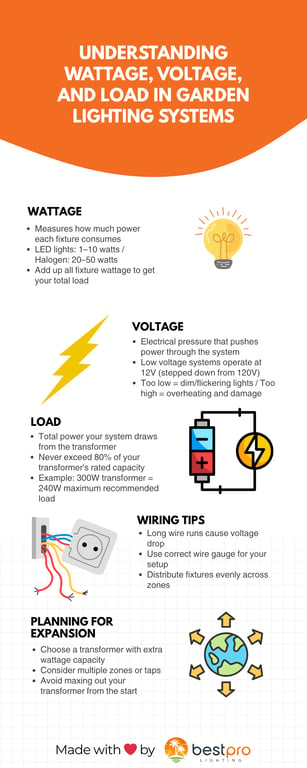
Learn the basics of wattage, voltage, and load in garden lighting systems with this clear infographic breakdown.
Q: What size landscape transformer do I need?
A: Add the wattage of all your garden lights and choose a transformer rated 20–30% higher than the total load.
Q: Can I overload a landscape lighting transformer?
A: Yes. Overloading can cause overheating, flickering lights, and transformer failure. Always stay below 80% capacity.
Q: Why are my garden lights dim at the end of the run?
A: This is usually caused by a voltage drop, often due to long wire runs or insufficient wire gauge.
Q: Is low voltage lighting safe for outdoor use?
A: Yes. Low voltage landscape lighting is specifically designed for outdoor environments and is safer than line voltage systems.
Q: Can I mix LED and halogen lights on one transformer?
A: Yes, but you must carefully calculate total wattage and ensure voltage compatibility.

Opening Hours
Monday – Friday 7:30am - 3:30pm PST

Need Help?
Fast answers to common questions.

Stay in the Loop
Be the first to know about new arrivals, sales & tips — it's free!